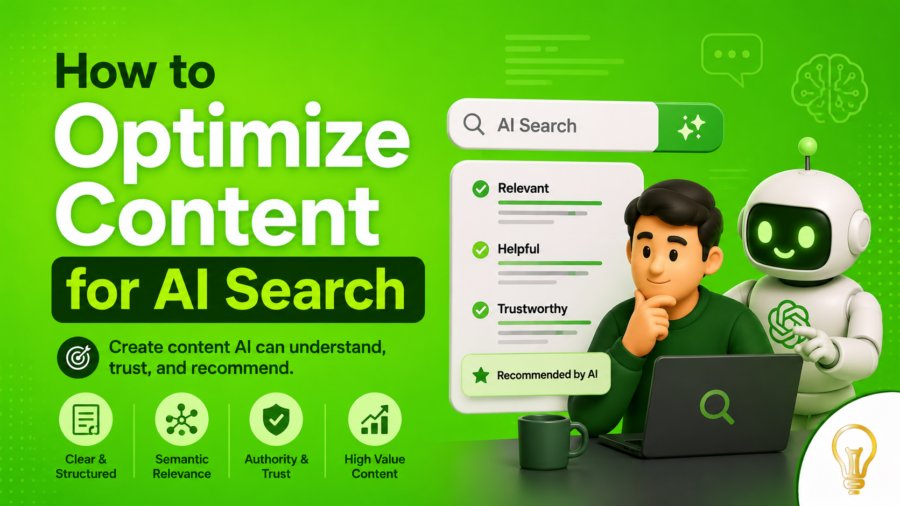
AI search engines are not a passing trend. ChatGPT, Claude, and Perplexity now answer millions of questions people used to type into Google. But here is the catch most creators miss: AI crawlers work completely differently from Googlebot, and optimizing only for Google leaves your content invisible to AI systems.
In this guide, you will learn exactly how to write and structure content that AI search engines want to cite. No fluff, just practical hints.
What AI Search Optimization Actually Means
AI search optimization means creating content that AI systems cite. For broader context on AI-powered marketing strategies, including search optimization, explore our comprehensive guide. AI search optimization means creating content that AI systems can easily understand, verify, and cite when answering user questions. It is not about manipulating algorithms. It is about making your content the best possible source for accurate answers.
The core difference from traditional SEO is structural. Google ranks pages and shows blue links. AI systems synthesize answers from multiple sources and present them with citations. When someone asks Perplexity about project management tools, the AI generates a paragraph citing three to five sources. Your content needs to be good enough to be one of those sources.
How the AI Citation Model Works
Modern AI systems decide what to cite in two steps. First, they retrieve relevant passages from training data or live web crawls. Second, they rank those passages by how directly they answer the user’s specific question. The top passages become the cited sources in the response.
This means there are two moments of truth. Getting crawled is the first. Being chosen as a citation over competing sources is the second. Most guides focus only on the first moment. But being selected as a source is just as important and far less discussed. We cover both, and go deeper into tracking in our guide to measuring AI search visibility.
Step 1: Write for the Question-Answer Format
Every AI query is a question. Your content should answer those questions directly and clearly.
Put the Direct Answer in the First Paragraph
The most important formatting trick for AI optimization is leading with the answer. AI systems need an immediate, verifiable answer to match against the user query. If the answer is buried in a long introduction, the AI might never find it.
If your article covers the best project management tools, your first paragraph should say: “The best project management tools for small teams in 2026 are Asana for flexible task management, Trello for visual workflows, and Notion for all-in-one collaboration.” Each section below then expands on that answer with specifics.
FAQ Sections Are Non-Negotiable
FAQ sections are among the best formats for AI optimization. Each Q-A pair maps directly to a search query. When an AI needs to answer “Is Asana free,” it can pull the exact answer from your FAQ without parsing an entire article.
FAQ content also gets picked up by traditional search through FAQ Schema, giving you visibility on both AI platforms and Google. Use the
FAQs
shortcode in every article.
Pro Hint
One article with 5-10 well-written FAQ items can generate multiple citations across different AI-generated answers. Each Q-A pair becomes an independent source the AI can pull from. This is the highest-ROI optimization for AI search visibility in 2026.
Step 2: Build E-E-A-T Into Every Page
E-E-A-T stands for Experience, Expertise, Authoritativeness, and Trust. Both Google and AI systems use these signals. For AI optimization, expertise and authoritativeness are the most critical.
Demonstrate Real Expertise Early
Do not hide credentials or experience behind vague statements. “Our team has tested every major tool” is less effective than “We tested 12 project management tools across 8 weeks with a 15-person remote team.” Specificity signals genuine knowledge to AI systems.
Generic advice gets generic citation weight. Specific, experience-backed advice gets cited more prominently in AI-generated answers.
Cite Your Sources and Link Out
When you reference data or external claims, link to the original source. This shows your content is based on verifiable facts, not guesswork. It also creates a web of trust that AI systems follow. For more on building authority, see our guide on E-E-A-T signals that help AI cite your content.
Step 3: Add Structured Data and Schema Markup
Structured data gives AI systems explicit information about your content. Without it, they guess. With schema, you tell the AI exactly what each section contains.
FAQ Schema Is the Highest-Impact Type
FAQ Schema maps questions to answers in JSON-LD format AI systems parse directly. One article with 10 FAQ items can generate 10 separate citation opportunities across different AI answers. The implementation workflow is covered in our FAQ Schema guide.
Other Schema Types Worth Adding
Add Article schema with author info and publication dates, HowTo schema for tutorials, and Product schema for tool reviews. Each gives AI systems more context for evaluating your content.
Step 4: Structure Content Hierarchically
AI systems parse hierarchical content far better than dense blocks of text. Clear H1, H2, and H3 headings help the AI understand how sections relate.
Follow the Heading Hierarchy Rule
Use exactly one H1 per page, H2 for main sections, H3 for subsections, and never skip levels. AI systems interpret heading levels as importance signals. For a full breakdown, see our guide to structuring content for AI search engines.
Keep Paragraphs Short
Aim for two to three sentences per paragraph. Each paragraph should make one point. This makes it easy for AI systems to extract your content as accurate citation chunks.
Step 5: Get AI Crawlers to Visit Your Site
Even perfect content is useless if AI crawlers cannot find it. AI crawlers have smaller budgets than Googlebot, so you need to actively invite them.
Check server logs for GPTBot, ClaudeBot, and PerplexityBot over the past 30 days. Zero hits means something is blocking them. Common culprits include robots.txt mistakes or server firewall rules. Some AI platforms also offer direct submission processes through their developer documentation.
Step 6: Track Your AI Search Performance
Standard analytics do not measure AI citations. You need new tracking methods. The most reliable approach is manual testing: ask AI platforms 5 to 10 questions about your topics weekly and track whether your content appears in the citations over time.
For a systematic monitoring framework, see our guide on measuring AI search visibility and tracking results.
| Optimization Step | Action Required | Impact |
|---|---|---|
| Lead with answers | Direct answer in first paragraph | Critical |
| FAQ sections | 5+ Q-A pairs with FAQs | Critical |
| FAQ Schema | JSON-LD structured data | High |
| E-E-A-T signals | Credentials, data, sources | High |
| Heading hierarchy | H1 > H2 > H3, no skipping | Medium |
| Short paragraphs | 2-3 sentences max | Medium |
| Crawler access | Verify AI bots can reach site | High |
| Track citations | Weekly AI platform testing | Medium |
Common Mistakes That Kill AI Visibility
Writing Content That Is Too Generic
AI systems have access to millions of sources. If your article covers the same ground as hundreds of others without adding original data or a unique perspective, there is no reason for the AI to cite your version. Add original research, contrarian takes, or specific examples that differentiate your content.
Ignoring Technical Barriers
If your site blocks AI crawlers via robots.txt or firewall rules, nothing else matters. Check your logs. If AI bots are not showing up, fix the technical issue first. Our troubleshooting guide walks through the diagnostic process.
Skipping the Author Signal
Every article needs a clear byline with author credentials. If an AI cannot determine who wrote the content, it will hesitate to cite it. Add author bio, author schema, and maintain consistent authorship across your site.
Frequently Asked Questions
(function(){
document.addEventListener(“click”,function(e){
var btn=e.target.closest(“.tdc-faq__question”);
if(!btn)return;
e.preventDefault();
var item=btn.closest(“.tdc-faq__item”);
if(!item)return;
var faq=item.closest(“.tdc-faq”);
var ans=item.querySelector(“.tdc-faq__answer”);
var open=item.classList.contains(“is-open”);
if(faq){var all=faq.querySelectorAll(“.tdc-faq__item.is-open”);for(var i=0;i<all.length;i++){if(all[i]!==item){all[i].classList.remove("is-open");var b=all[i].querySelector(".tdc-faq__question");if(b)b.setAttribute("aria-expanded","false");var a=all[i].querySelector(".tdc-faq__answer");if(a)a.style.maxHeight=null;}}}
if(open){item.classList.remove("is-open");btn.setAttribute("aria-expanded","false");if(ans)ans.style.maxHeight=null;}
else{item.classList.add("is-open");btn.setAttribute("aria-expanded","true");if(ans)ans.style.maxHeight=ans.scrollHeight+"px";}
});
})();
AI search optimization means creating content that AI systems like ChatGPT, Claude, and Perplexity can understand, verify, and cite when answering user questions. It focuses on structure, clarity, and authority signals that AI models prioritize over traditional SEO factors alone.
AI search generates synthesized answers from multiple sources instead of showing ranked blue links. AI looks for clear factual content to quote directly, while Google uses backlinks, keyword relevance, and traditional ranking signals to rank individual pages.
Yes, significantly. FAQ Schema maps questions to answers in a format AI systems parse and cite directly. One article with 5-10 FAQ items can generate multiple separate citations. It is the highest-ROI structured data investment for AI visibility.
Expertise and authoritativeness matter most for AI systems. Show real credentials, cite specific data with sources, maintain consistent authorship, and link out to authoritative external sources. These signals tell AI models your content is trustworthy and worth citing.
Check server access logs for GPTBot, ClaudeBot, and PerplexityBot user-agents. If none appear in the past 30 days, your site is not being found. Check robots.txt, firewall settings, and consider submitting your site to each AI platform directly.
Aim for 1,500 to 3,000 words for comprehensive topics. Length provides more citation opportunities, but quality matters more than quantity. A focused 1,500-word article with clear answers outperforms a 4,000-word article with generic filler.