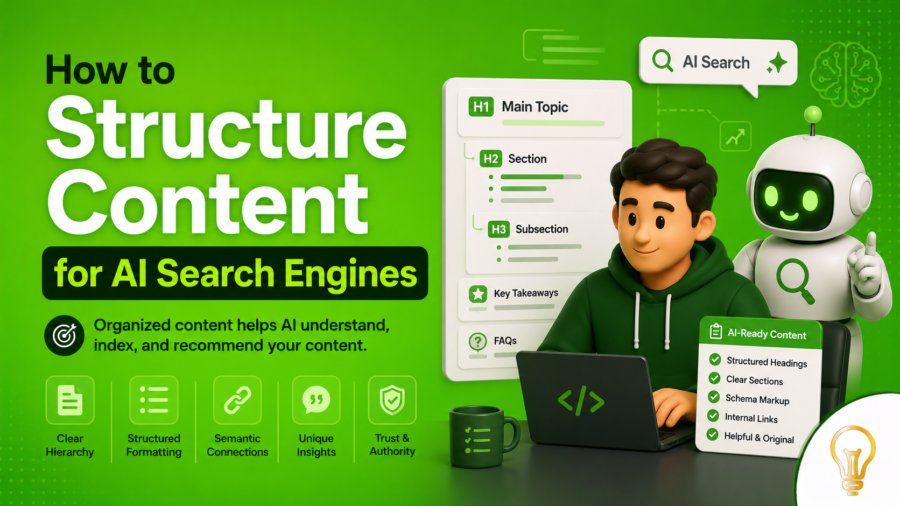
AI search engines parse content very differently from traditional search engines. Google ranks pages by analyzing signals across your entire site. AI systems extract specific passages to answer individual questions. This means your content structure matters more than ever, but the rules are different.
In this guide, we cover the exact heading hierarchy, paragraph structure, and formatting decisions that maximize your chances of being cited by AI systems like ChatGPT, Claude, and Perplexity.
Why Content Structure Matters More for AI
When Google ranks your page, it analyzes hundreds of signals across your entire site. Your H2 headings matter, but so do your backlinks, site speed, mobile-friendliness, and a hundred other factors. One poorly structured section will not sink your rankings.
AI systems work differently. They extract specific passages that directly answer a user’s question. If your content is not structured to make those passages easy to find and extract, the AI will source from a competitor who organized their content better. Every paragraph, heading, and section either helps or hurts your citation chances.
The Extraction Problem
Here is a real example. Post A has a 2,000-word article with three long paragraphs. Post B has the same information organized with clear H2 sections, H3 subheadings, and short paragraphs. When a user asks an AI about that topic, Post A might get quoted inaccurately because the AI has to guess where the relevant information is. Post B gets cited precisely because the AI can find the exact passage that answers the question.
TheHeading Hierarchy: H1, H2, H3 Rules
Heading structure is the skeleton of your content. AI systems use headings to understand what each section covers and how sections relate to each other.
Use Exactly One H1 Per Page
Always use exactly one H1 per page. The H1 should contain your primary keyword and clearly state what the page is about. Multiple H1s confuse AI systems about the page’s main topic. No H1 at all means the AI has to guess your primary focus.
H2 for Main Sections, H3 for Sub-Sections
Use H2 for your main sections and H3 for subsections within those sections. Never skip levels, and never use H4 unless you have a genuinely complex topic that needs it. Each heading level signals its relative importance to AI parsers.
This hierarchy also makes your content more scannable for human readers. The best content structure serves both audiences simultaneously. See our guide on optimizing content for AI search for the full picture.
Make Headings Descriptive and Keyword-Rich
Each heading should clearly describe what the section covers. Bad example: “More Details.” Good example: “How FAQ Schema Increases AI Citation Rate.” AI systems use headings to categorize content, so make categorization easy with descriptive labels.
Pro Hint
Before publishing, read only your H2 and H3 headings in sequence. If they form a coherent outline that tells the full story of your article, your structure is solid. If gaps appear or sections feel disconnected, reorganize before publishing.
Paragraph Length and Sentence Structure
Short paragraphs are essential for AI content structure. AI systems extract citation chunks from paragraphs, and short focused paragraphs are far easier to extract accurately.
The Two-to-Three Sentence Rule
Aim for two to three sentences per paragraph. Each paragraph should make a single point. This makes it easy for AI systems to quote your content accurately without losing context.
Vary Sentence Length
Mix short punchy sentences with medium-length ones. This creates a reading rhythm that keeps both humans and AI systems engaged. All-same-length paragraphs feel mechanical to readers and harder for AI to parse cleanly.
Lists and Structured Data Within Content
Lists are among the most citeable content formats for AI systems. Ordered lists for steps, unordered lists for features or tips, and comparison tables for evaluations all get extracted frequently by AI platforms.
Use Tables for Comparisons
When comparing tools, features, or options, use a table format. AI systems love comparison tables because each cell is a discrete, quotable fact. Use the Every H2 section in your content should have at least one H3 subsection. A section heading followed by a single short paragraph looks thin to both human readers and AI systems. It signals that the topic was not covered thoroughly enough to be worth citing. For each H2, ask yourself: could this section stand alone as a mini-guide? If yes, it has enough depth. If not, add H3 subsections that break the topic into smaller, more detailed pieces. Each subsection should explain a specific aspect with examples or data. A well-structured article for AI readability follows this pattern: FAQs This structure gives AI systems multiple angles to find and cite your content. When the AI needs to answer any question related to your topic, there is a well-organized passage ready to be quoted. For the complete optimization picture, combine strong content structure with E-E-A-T signals and FAQ Schema. Our guide on optimizing content for AI search engines ties everything together. Frequently Asked Questions AI systems extract specific passages to answer user questions. Well-structured content with clear headings and short paragraphs makes it easy for AI to find, understand, and accurately quote your content. Poor structure means AI cannot find the relevant passages. Exactly one H1 per page. Use it for your primary keyword and main topic statement. Multiple H1s confuse AI systems about your page’s primary focus. Zero H1s leave the AI guessing. Use H1 for the main title, H2 for major sections, and H3 for subsections. Never skip levels. AI systems interpret heading levels as importance signals, so consistency helps them understand your content structure. Aim for 2-3 sentences per paragraph. Each paragraph should make a single point. Short focused paragraphs are easier for AI systems to extract accurately as citation chunks without losing context. Yes, significantly. AI systems love lists and comparison tables because each item or cell is a discrete, quotable fact. A well-formatted comparison table can generate multiple citations across different AI-generated answers. Read only your H2 and H3 headings in sequence. If they form a coherent outline that tells the full story, your structure is solid. You can also ask AI systems questions about your topic and see how accurately they quote your content. shortcode for AI-friendly comparison tables in WordPress.
Content Depth and Section Balance
The Depth Test
Element Rule Why It Matters for AI H1 count Exactly one per page Helps AI identify main topic Paragraph length 2-3 sentences Easier accurate extraction H2 sections Each needs 1+ H3 sub-section Demonstrates topic depth Heading descriptiveness Keyword-rich, specific labels Helps AI categorize content Lists and tables Use for comparisons Highly citeable format Direct answers In first 1-2 paragraphs Quick match for AI queries What Great AI-Friendly Structure Looks Like