You have spent hours writing a detailed article. It covers the topic thoroughly. But when someone asks an AI search engine about your subject, your content never appears in the answer. If this sounds familiar, the missing ingredient might be E-E-A-T.
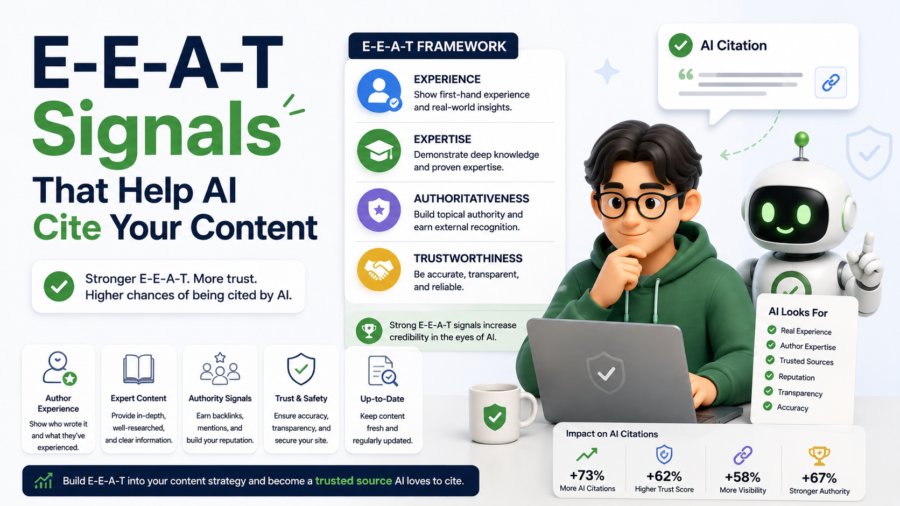
E-E-A-T stands for Experience, Expertise, Authoritativeness, and Trust. These four signals have shaped how Google ranks pages for years. Now they shape how AI systems decide whether to cite your work. Understanding this shift matters if you want your content to show up in AI-generated answers.
Here is the honest truth: AI search engines are far more selective than traditional search. Google indexes billions of pages. An AI system like Perplexity or ChatGPT might only surface three to five sources in response to a query. Your content needs to stand out. E-E-A-T signals are the clearest path to that visibility.
What E-E-A-T Actually Means for AI Citation
Google introduced E-E-A-T as part of its Search Quality Rater Guidelines. The four pillars each serve a distinct purpose in how both traditional search engines and AI systems evaluate your content.
Experience
Experience signals show that the content creator has hands-on, real-world involvement with the topic. For AI citation purposes, this means demonstrating that you have actually used the product, tested the method, or lived through the situation you are describing.
An article about home office setup written by someone who has configured twelve remote workspaces carries more experience signal than one written by a blogger who has never worked from home. AI systems look for these clues in your writing: specific anecdotes, named tools you have personally tested, photos or data from real projects, and honest mentions of what did not work.
The easiest way to boost experience signals is to share personal results. Instead of saying “this strategy improves conversion rates,” say “we tested this approach over 90 days and increased conversions from 2.1 percent to 3.8 percent.” That specificity does two things: it proves you actually ran the test and it gives AI systems concrete data to reference.
Expertise
Expertise signals demonstrate deep knowledge of the subject matter. AI systems evaluate expertise through the accuracy and depth of your content. They cross-reference claims against their training data and against authoritative sources they can verify.
Practical ways to establish expertise include citing specific research with author names and publication dates, explaining the “why” behind recommendations rather than just the “what,” covering edge cases and limitations that a beginner would miss, and using precise terminology correctly without overloading the reader.
One often-overlooked tactic is to address common misconceptions. When you correct a widely-held but incorrect belief in your field, you signal expertise to both human readers and AI systems. AI models are trained on correct information and can detect when content aligns with verified facts.
Authoritativeness
Authority signals tell AI systems that your site or brand is a recognized voice in your field. This is the hardest E-E-A-T pillar to build and the one that most directly determines whether your content gets cited instead of a competitor’s.
Authority accumulates over time through backlinks from reputable sources, mentions on industry sites, publication on recognized platforms, consistent output on a specific topic, and recognition such as awards, certifications, or expert status on platforms like LinkedIn.
The practical shortcut here is to earn links from established publications. A single mention on a site like TechCrunch or Smashing Magazine carries more authority weight than twenty mentions on random blogs. Focus your outreach efforts accordingly.
Trust
Trust signals confirm that your content is reliable, accurate, and safe to reference. AI systems prioritize sources they can trust because citing unreliable information damages the quality of their answers.
Trust-building elements include a clear contact page, transparent authorship with real names and bios, cited sources with links to original research, regular content updates with visible dates, HTTPS security, and an accessible privacy policy.
One quick win for trust signals: add an author bio box to every article. Include a real photo, a link to the author’s professional profile, and a brief summary of their relevant experience. If you want to go further, see our guide to FAQ schema and structured data for AI search for additional trust-building tactics.
Pro Hint
Trust is the E-E-A-T pillar that AI systems weight most heavily when deciding whether to cite your content. If you only have time to improve one area, focus on trust signals first. Add author bios, cite your sources, and make your contact information easy to find.
How AI Systems Evaluate E-E-A-T Signals Differently From Google
Google uses E-E-A-T through its human quality raters and algorithmic signals. AI search engines use a different evaluation method. They do not have human raters scanning your page. Instead, they analyze your content structurally and semantically to determine whether it qualifies as a citable source.
What AI Systems Actually Look For
AI systems like the ones behind Perplexity, Google’s AI Overviews, and Claude evaluate source material using the same underlying principles but applied through natural language processing. They look for author credentials mentioned in the text, publication dates and update histories, references to peer-reviewed or widely-cited sources, consistency of claims with verified information, and specificity of data and examples.
The key difference is that AI systems are more likely to surface content from sources they have seen frequently in their training data. A site that has been consistently cited across the web for years has a structural advantage over a newer site with excellent content but fewer references.
How AI Crawlers Process Your Page
When an AI crawler visits your page, it extracts the text content and analyzes it in context. It does not just read headings and keywords the way Google’s crawler did in earlier years. It evaluates the full body of your article for authority signals.
The crawler checks whether author information is present near the article content. It evaluates whether sources are cited with enough detail to verify. It assesses whether the tone and structure match what it has learned from high-trust sources in its training data. And importantly, it checks whether claims in your article align with information from sources it considers authoritative.
For a deeper look at optimizing your content for this new search paradigm, check out our guide to optimizing content for AI search in 2026.
Practical Steps to Strengthen Each E-E-A-T Signal
Knowing what E-E-A-T means is one thing. Acting on it is another. Here is a practical breakdown of steps you can take for each signal, ranked by difficulty and impact.
Experience: Add First-Person Results and Testing Data
Start with the easiest change: add a results section to every how-to article. Instead of writing purely theoretical advice, include actual numbers from your own testing. If you review a project management tool, share the exact metrics you measured: setup time, learning curve, team adoption rate, cost per seat.
Behind this advice is a simple principle. AI systems can verify numbers. They can cross-reference dates. They can compare your claims against their training data. Vague statements like “this tool is highly effective” do not survive that scrutiny. Specific claims like “we measured a 34 percent reduction in onboarding time over 8 weeks” do.
Expertise: Cite Sources and Explain the “Why”
Every factual claim in your article should have a source. Not a generic link to Google Scholar or Wikipedia. Link to the actual study, the original blog post that introduced the concept, or the product documentation that confirms your point.
When you explain the reasoning behind a recommendation, you build expertise signals. Stacking commands and telling users what to run is helpful. Explaining why each command matters and what happens under the hood builds trust with AI systems that need to understand the reliability of your content.
Authoritativeness: Build a Recognizable Brand Presence
Authority grows through consistency. Publish on your topic regularly. Build backlinks from sites that your target audience already trusts. Get quoted or featured on industry podcasts and newsletters. Each of these actions adds a data point that AI systems use to calibrate your authority.
The 80-20 insight here: most authority-building activities take months to show results. But one action delivers immediate value. Claim and optimize your Google Knowledge Panel or equivalent entity profile. When AI systems can connect your brand name to a verified, detailed profile, your citation eligibility jumps significantly.
Trust: Make Your Content Verifiable and Transparent
Trust is built through systematic transparency. Add an author box with a real photo and professional credentials to every article. Publish content with visible dates and update histories. Include a clear about page that explains who runs the site and why.
On the technical side, ensure your site uses HTTPS throughout. Fix mixed content warnings. Add a privacy policy and terms page even if they are simple. These are baseline trust signals that AI systems expect from any source they consider for citation.
Common E-E-A-T Mistakes That Kill Your AI Citation Chances
Most content creators undermine their E-E-A-T signals without realizing it. Here are the most common mistakes and how to fix them.
Publishing Content Without Author Attribution
Ghost-written content with no byline is the single fastest way to lose trust signals. AI systems and human readers alike need to know who wrote the content and why that person is qualified. If you publish under a brand name, add individual author bylines to every article.
Making Claims Without Evidence
Every statistic, recommendation, and factual claim needs a source. Not linking your claims to verifiable data undermines expertise and trust simultaneously. AI systems are trained to detect unsupported claims and will deprioritize sources that frequently make them.
Ignoring Content Freshness
AI systems check publication and update dates. An article from 2019 about a software tool that has had three major releases since then presents a trust problem. Even if the core advice is still valid, outdated dates signal that the content has not been maintained. Update your publication dates when you refresh content.
The Long-Term Payoff of Strong E-E-A-T Signals
Building E-E-A-T is not a quick fix. It requires consistent effort over months or years. But the payoff compounds over time. Every article you publish with strong signals adds to your site’s overall authority profile. Every backlink, mention, and citation reinforces your position as a trusted source.
As AI search becomes the primary way people find information, the sites with the strongest E-E-A-T signals will dominate citation results. The sites that treated content as a volume game will struggle to gain visibility. The sites that invested in quality, transparency, and trust will find themselves consistently surfaced by AI systems.
FAQ: E-E-A-T and AI Citations
Frequently Asked Questions
E-E-A-T stands for Experience, Expertise, Authoritativeness, and Trust. These four signals represent how search engines and AI systems evaluate the quality and credibility of web content before deciding whether to cite or rank it.
Yes. While Google’s quality raters formally evaluate E-E-A-T for search rankings, AI systems like Perplexity, ChatGPT, and Google’s AI Overviews use similar criteria when selecting sources. They prioritize content from authors with demonstrated expertise, from sites with established authority, and from sources that present transparent, trustworthy information.
Trust is generally the most critical signal for AI citation. AI systems need to be confident that the information they surface is accurate and reliable. Sources with clear author attribution, cited references, visible publication dates, and transparent editorial policies have a significant advantage in being cited by AI search engines.
Building strong E-E-A-T signals is a long-term process, typically taking six months to two years depending on your starting point. The timeline depends on factors like your existing domain authority, publishing frequency, quality of your expert network, and your ability to earn backlinks from reputable sources. Consistent, high-quality content published over time is the fastest path.
It is possible but difficult. AI systems draw heavily from established sources in their training data. A new website with no authority footprint has limited visibility. The most effective strategy is to publish comprehensive, well-sourced content consistently, earn backlinks from authoritative sites in your niche, and build author credibility through guest posts, interviews, and professional profiles.
FAQ schema, also known as FAQPage structured data, helps search engines understand the questions and answers on your page. While it does not directly boost E-E-A-T scores, it enhances content discoverability and can increase the chance that your content appears in rich results. Combined with strong E-E-A-T signals, FAQ schema gives AI systems clearer signals about your content’s scope and reliability. For a full breakdown, see our guide to FAQ schema and structured data for AI search.