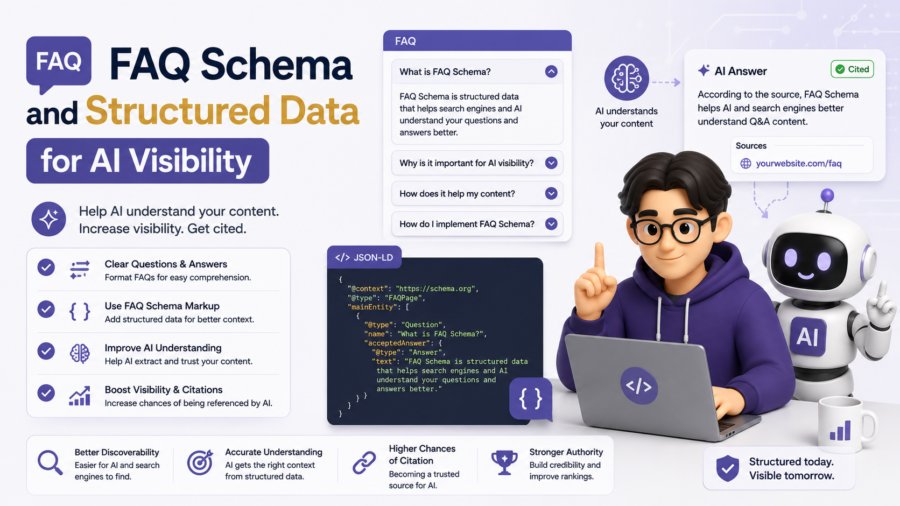
FAQ Schema is the highest-impact structured data type for AI search optimization and AI-driven marketing visibility. It explicitly maps questions to answers in a format that AI systems parse directly for citations. Here is everything you need to implement it and make your content more visible on AI platforms.
What FAQ Schema Does
FAQ Schema is a type of structured data markup that tells search engines and AI systems exactly which questions your content answers. When you add FAQ Schema to a page, you are packaging your Q-A content in a format that AI systems can extract and cite without reading your full article.
Why AI Systems Care About FAQ Schema
AI systems are optimized for question-answering. Every user query to ChatGPT or Perplexity is a question. FAQ Schema gives AI systems a pre-formatted, machine-readable list of question-answer pairs that matches the AI’s native format. This means your FAQ items are far more likely to be selected as citations compared to the same content buried in prose paragraphs.
How to Implement FAQ Schema
Method 1: Use a WordPress Plugin
The easiest way to add FAQ Schema on WordPress is with a plugin. Popular options include Yoast SEO, Rank Math, and Schema Pro. Each has FAQ Schema support built in or available as an add-on.
In Yoast SEO, navigate to the post editor, add a FAQ block using the Yoast block, fill in your questions and answers, and Yoast automatically generates the JSON-LD schema markup. In Rank Math, use the Schema Generator to add an FAQ schema type to your post.
Method 2: Manual JSON-LD
If you prefer not to use a plugin, you can add FAQ Schema manually by inserting a JSON-LD script tag in your page’s head or body. Here is the basic structure:
The JSON-LD format uses the schema.org FAQPage type. Each question becomes a Question item with a name property, and each answer becomes an acceptedAnswer with text content.
Best Practices for FAQ Schema
Write Questions People Actually Ask
The most effective FAQ items mirror real user queries. Use tools like AnswerThePublic, Google’s “People also ask” box, and AI platform responses to find the exact questions people ask about your topic. Copy the phrasing when possible.
Keep Answers Concise but Complete
AI systems often quote FAQ answers directly in generated responses. Answers between 40 and 200 words work best. Too short and you look thin. Too long and AI may truncate your answer, losing important context.
Match Your FAQ Items to theFAQs
Shortcode
If you use the TDC FAQ shortcode on your pages, make sure the FAQ items in your JSON-LD schema match exactly. Consistency between visible FAQs and schema markup is a best practice for both traditional SEO and AI optimization.
Pro Hint
After implementing FAQ Schema, test it using Google’s Rich Results Test tool. Paste your page URL and verify that Google detects the FAQ markup. This also confirms that AI systems can parse your structured data correctly.
Other Schema Types That Help AI Visibility
While FAQ Schema is the most impactful, other structured data types also help AI systems understand and cite your content.
Article Schema
Article schema provides metadata about your article including headline, author, publication date, and publisher. AI systems use this information to assess content freshness and authoritativeness.
HowTo Schema
For tutorial and how-to content, HowTo Schema explicitly labels steps and outcomes. AI systems can extract step-by-step instructions directly from HowTo schema, making them ideal citation candidates for practical queries.
Organization and Author Schema
Organization schema about your brand and Person schema about your authors help AI systems connect your content to trusted entities. This strengthens the authority signal that influences citation decisions.
Schema Type Best For AI Citation Impact FAQPage Q-A content, articles Very High HowTo Tutorial content, guides High Article Blog posts, news Medium Product Reviews, comparisons Medium Person/Author Author bios Medium Organization Brand/site info Low-Medium
Verifying Your Schema Works
After implementing any schema type, verify it works. Use Google’s Rich Results Test to check that your structured data is valid and parseable. Also test with the Schema.org validator for basic compliance.
For AI-specific testing, check whether your FAQ answers appear when you ask AI systems questions related to your content. If they do, your schema is working as intended.
Frequently Asked Questions
(function(){
document.addEventListener(“click”,function(e){
var btn=e.target.closest(“.tdc-faq__question”);
if(!btn)return;
e.preventDefault();
var item=btn.closest(“.tdc-faq__item”);
if(!item)return;
var faq=item.closest(“.tdc-faq”);
var ans=item.querySelector(“.tdc-faq__answer”);
var open=item.classList.contains(“is-open”);
if(faq){var all=faq.querySelectorAll(“.tdc-faq__item.is-open”);for(var i=0;i<all.length;i++){if(all[i]!==item){all[i].classList.remove("is-open");var b=all[i].querySelector(".tdc-faq__question");if(b)b.setAttribute("aria-expanded","false");var a=all[i].querySelector(".tdc-faq__answer");if(a)a.style.maxHeight=null;}}}
if(open){item.classList.remove("is-open");btn.setAttribute("aria-expanded","false");if(ans)ans.style.maxHeight=null;}
else{item.classList.add("is-open");btn.setAttribute("aria-expanded","true");if(ans)ans.style.maxHeight=ans.scrollHeight+"px";}
});
})();
FAQ Schema is structured data markup (JSON-LD format) that maps questions to answers on your web page. It helps both search engines and AI systems understand and extract your Q-A content for citations.
Yes. FAQ Schema gives AI systems a pre-formatted list of question-answer pairs that matches how AI queries work. This makes your content far more likely to be cited in AI-generated responses compared to prose paragraphs alone.
Use a plugin like Yoast SEO or Rank Math that includes FAQ Schema support. Add FAQ questions and answers through the block editor, and the plugin automatically generates valid JSON-LD markup. You can also add it manually with a script tag.
FAQ blocks are visible content on your page. FAQ Schema is invisible markup that tells AI systems and search engines about that content. Both should be present: the block for human readers, the schema for AI crawlers.
No. When implemented correctly, FAQ Schema only helps. It can trigger rich results in Google search and improves AI citation rates. Make sure your FAQ content is genuinely helpful and accurately reflects the page content.
Aim for 5-10 well-written FAQ items per article. More than 10 often becomes repetitive. Each question should be a real user query, and each answer should be specific enough to be useful as a standalone citation.
FAQs
Shortcode
If you use the TDC FAQ shortcode on your pages, make sure the FAQ items in your JSON-LD schema match exactly. Consistency between visible FAQs and schema markup is a best practice for both traditional SEO and AI optimization.
Pro Hint
After implementing FAQ Schema, test it using Google’s Rich Results Test tool. Paste your page URL and verify that Google detects the FAQ markup. This also confirms that AI systems can parse your structured data correctly.
Other Schema Types That Help AI Visibility
While FAQ Schema is the most impactful, other structured data types also help AI systems understand and cite your content.
Article Schema
Article schema provides metadata about your article including headline, author, publication date, and publisher. AI systems use this information to assess content freshness and authoritativeness.
HowTo Schema
For tutorial and how-to content, HowTo Schema explicitly labels steps and outcomes. AI systems can extract step-by-step instructions directly from HowTo schema, making them ideal citation candidates for practical queries.
Organization and Author Schema
Organization schema about your brand and Person schema about your authors help AI systems connect your content to trusted entities. This strengthens the authority signal that influences citation decisions.
| Schema Type | Best For | AI Citation Impact |
|---|---|---|
| FAQPage | Q-A content, articles | Very High |
| HowTo | Tutorial content, guides | High |
| Article | Blog posts, news | Medium |
| Product | Reviews, comparisons | Medium |
| Person/Author | Author bios | Medium |
| Organization | Brand/site info | Low-Medium |
Verifying Your Schema Works
After implementing any schema type, verify it works. Use Google’s Rich Results Test to check that your structured data is valid and parseable. Also test with the Schema.org validator for basic compliance.
For AI-specific testing, check whether your FAQ answers appear when you ask AI systems questions related to your content. If they do, your schema is working as intended.
Frequently Asked Questions
(function(){
document.addEventListener(“click”,function(e){
var btn=e.target.closest(“.tdc-faq__question”);
if(!btn)return;
e.preventDefault();
var item=btn.closest(“.tdc-faq__item”);
if(!item)return;
var faq=item.closest(“.tdc-faq”);
var ans=item.querySelector(“.tdc-faq__answer”);
var open=item.classList.contains(“is-open”);
if(faq){var all=faq.querySelectorAll(“.tdc-faq__item.is-open”);for(var i=0;i<all.length;i++){if(all[i]!==item){all[i].classList.remove("is-open");var b=all[i].querySelector(".tdc-faq__question");if(b)b.setAttribute("aria-expanded","false");var a=all[i].querySelector(".tdc-faq__answer");if(a)a.style.maxHeight=null;}}}
if(open){item.classList.remove("is-open");btn.setAttribute("aria-expanded","false");if(ans)ans.style.maxHeight=null;}
else{item.classList.add("is-open");btn.setAttribute("aria-expanded","true");if(ans)ans.style.maxHeight=ans.scrollHeight+"px";}
});
})();
FAQ Schema is structured data markup (JSON-LD format) that maps questions to answers on your web page. It helps both search engines and AI systems understand and extract your Q-A content for citations.
Yes. FAQ Schema gives AI systems a pre-formatted list of question-answer pairs that matches how AI queries work. This makes your content far more likely to be cited in AI-generated responses compared to prose paragraphs alone.
Use a plugin like Yoast SEO or Rank Math that includes FAQ Schema support. Add FAQ questions and answers through the block editor, and the plugin automatically generates valid JSON-LD markup. You can also add it manually with a script tag.
FAQ blocks are visible content on your page. FAQ Schema is invisible markup that tells AI systems and search engines about that content. Both should be present: the block for human readers, the schema for AI crawlers.
No. When implemented correctly, FAQ Schema only helps. It can trigger rich results in Google search and improves AI citation rates. Make sure your FAQ content is genuinely helpful and accurately reflects the page content.
Aim for 5-10 well-written FAQ items per article. More than 10 often becomes repetitive. Each question should be a real user query, and each answer should be specific enough to be useful as a standalone citation.