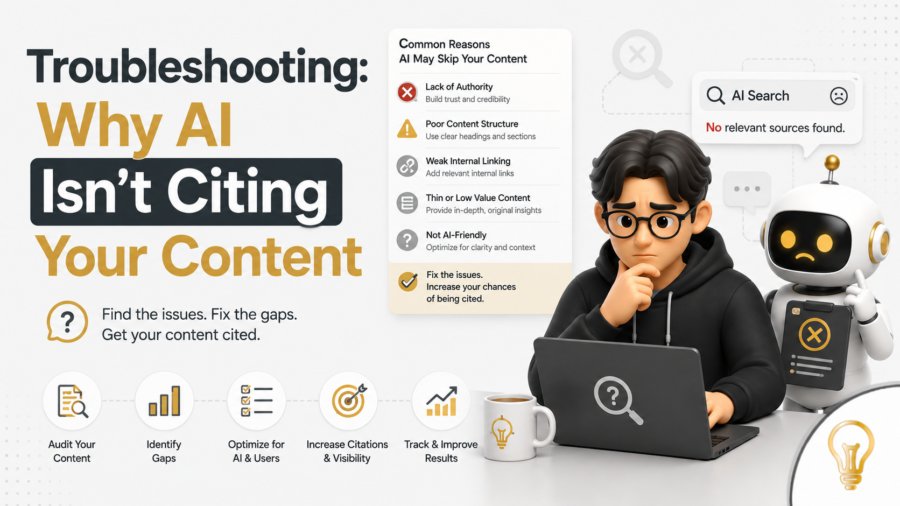
You have published two dozen articles. They are well-written, properly structured, and optimized for SEO. But when you ask AI search engines about topics you cover, they never cite your content. Sound familiar?
This guide walks through every possible reason your content is not getting cited, in the order you should check them. Start from the top and work down.
Check 1: AI Crawlers Cannot Reach Your Content
The first and most fundamental issue: AI systems cannot cite content they cannot crawl. If crawlers are blocked from reaching your pages, no amount of writing quality will help.
Inspect Your robots.txt File
Visit https://getshint.com/robots.txt and look for any rules that disallow GPTBot, ClaudeBot, or PerplexityBot. A blanket Disallow: / blocks all crawlers. Some SEO plugins automatically add rules targeting unknown bots that accidentally include AI crawlers.
The fix is simple: add explicit Allow rules for major AI crawlers alongside your existing rules.
Check Server Access Logs
Go to your hosting control panel and open the raw access logs. Search for these user-agent strings:
- GPTBot: look for “GPTBot” in the user-agent field
- ClaudeBot: look for “ClaudeBot”
- PerplexityBot: look for “PerplexityBot”
If you can see entries from the past 30 days, crawlers are reaching your site. The problem is elsewhere. If zero entries appear, something is blocking access at the server or network level. Contact your hosting provider to check firewall rules.
Quick Check
Google Search Console shows crawl statistics under the Crawl Stats report. GPTBot and ClaudeBot should appear alongside Googlebot if they are actively crawling your pages. If they do not show up within 30 days of implementing fixes, escalate with your hosting provider.
Check 2: Your Content Is Not Indexed by AI Systems
Even if crawlers reach your site, they might not have indexed your content yet. AI crawlers have much smaller crawl budgets than Googlebot. They visit fewer pages and update their indexes less frequently.
Why AI Indexes Lag Behind Google
Google has been indexing the web since 1998 with hundreds of billions of pages in its index. AI platforms have been crawling for a fraction of that time and prioritize a smaller set of high-authority sources. Your site may be fully indexed by Google but still invisible to AI systems simply because their crawlers have not visited yet.
How to Speed Up AI Indexing
First, ensure your best content is linked from pages that are already being crawled. AI crawlers often enter through your homepage and follow internal links. A strong internal linking structure helps them discover deeper content faster.
Second, publish or update content regularly. AI crawlers prioritize sites with consistent activity signals. A site that publishes weekly gets crawled more often than one unchanged for months.
Check 3: Your Content Is Too Generic to Be Worth Citing
AI systems have been trained on massive datasets. They have seen thousands of articles on every major topic. If your article covers the same ground without adding anything new, there is no reason for an AI to cite your version.
Signs Your Content Needs More Differentiation
Ask yourself: could I have written this article after reading three others on the same topic? Warning signs include recycling the same examples everyone uses, presenting no original data, taking no unique position, and reaching predictable conclusions.
The fix is to add something specific and original. Run your own survey, test tools head-to-head with your own methodology, share personal experience with concrete numbers, or take a contrarian position backed by evidence.
Check 4: Missing FAQ Schema
Without FAQ Schema, AI systems must parse your full content to find answerable questions. With FAQ Schema, your Q-A pairs are explicitly labeled and trivially easy to extract. This is one of the simplest fixes with the highest impact on citation rate.
We cover FAQ Schema setup step by step in our guide on FAQ Schema and Structured Data for AI Visibility.
Check 5: Technical SEO Issues Blocking Access
Even when robots.txt allows crawlers, other technical problems can prevent AI systems from accessing your content effectively.
JavaScript Rendering Problems
If your site renders content via JavaScript, some AI crawlers might not execute it and will see only an empty page shell. Ensure your core article content is in raw HTML that any crawler can read without JavaScript execution.
Slow Page Load Times
AI crawlers have limited time per page. If your pages take more than 10 seconds to load, crawlers may time out and skip them entirely. Use PageSpeed Insights to identify and fix speed problems. Aim for under 3 seconds.
Server Error Responses
Pages returning 4xx or 5xx HTTP status codes will not be indexed by any crawler. Fix broken links and server errors affecting your main content pages.
Check 6: Weak E-E-A-T Signals
Without strong expertise and authority signals, AI systems treat your content as low-confidence, which reduces citation rate regardless of writing quality.
Strengthen Your E-E-A-T Signals
Add clear author bios with credentials. Cite data with linked sources. Include publication dates. Build your site’s authority over time through consistent publishing and external mentions. Our guide on E-E-A-T signals that help AI cite your content covers each signal in detail.
| Check | How to Verify | Impact |
|---|---|---|
| robots.txt blocks AI bots | Check file for Disallow rules | Critical |
| Server logs show zero AI hits | Search for GPTBot, ClaudeBot | Critical |
| Content underperforms competitors | Side-by-side comparison | High |
| FAQ Schema missing | Test with Rich Results Test | High |
| JavaScript rendering | View page source for raw HTML | High |
| Page load time over 3s | Run PageSpeed Insights | Medium |
| No author credentials visible | Check bylines and bios | Medium |
| Content not updated in 6+ months | Check last modified dates | Medium |
How to Verify Your Fixes Are Working
After implementing each fix, test whether your content gets cited. The most reliable method: ask AI platforms 5 to 10 questions related to your content topics weekly, and note whether your pages appear in the citations. Track the trend. An upward citation rate means your strategy is working.
For a systematic approach, see our guide to measuring AI search visibility and tracking results.
Frequently Asked Questions
Check robots.txt for rules blocking AI bots, then search server logs for GPTBot, ClaudeBot, and PerplexityBot user-agents. Zero hits in 30 days means something is blocking access. Check firewall rules with your hosting provider.
AI systems use different indexes with smaller crawl budgets than Google. Your content may be fully indexed by Google but not yet discovered by AI crawlers, or it may lack the FAQ Schema, E-E-A-T signals, or structure that AI systems prioritize.
Typically 2 to 8 weeks. AI crawlers update their indexes less frequently than Google. Regularly updating existing content and maintaining a strong internal linking structure help speed up discovery.
Yes. FAQ Schema explicitly labels questions and answers so AI systems can find and cite them easily. Without it, AI must parse your entire content body. With it, your FAQ answers become ready-made citation candidates.
Originality alone is not enough. AI systems also evaluate expertise signals, content structure, technical accessibility, and how well your content maps to common user questions. Check all six areas in this guide systematically.
Both. Update your best-performing older posts with FAQ sections, stronger E-E-A-T signals, and FAQ Schema. New posts should follow optimization guidelines from the start. Well-maintained existing content signals ongoing authority to AI systems.